


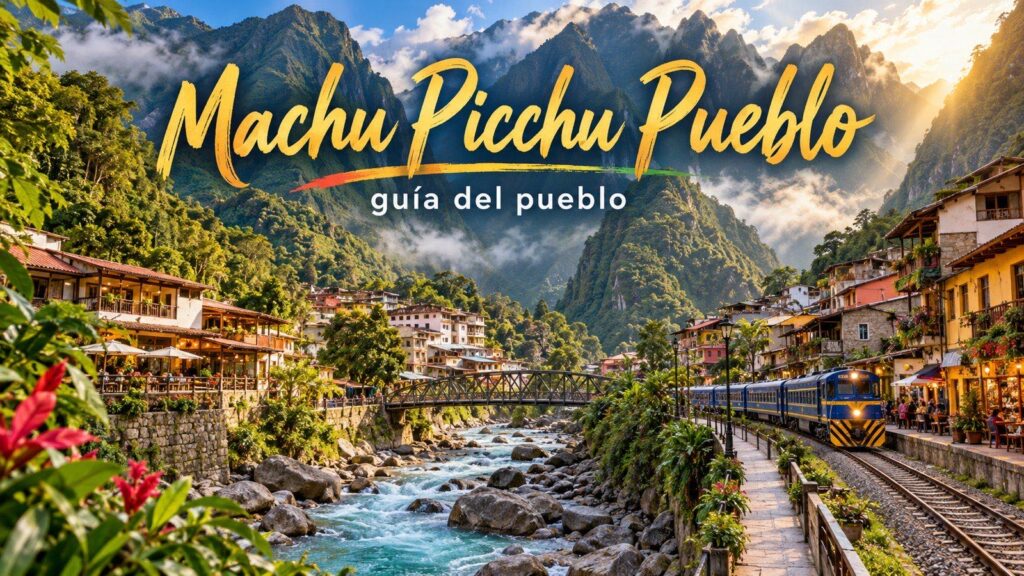
Quick answer: Aguas Calientes, also called Machu Picchu Town, is the village at the foot of the citadel that you can only reach by train or on foot along the railway (there is no road). It is fully pedestrian, has lodging areas for every budget, hot springs, a cheap local market, and a tourist strip full of restaurants. One night is usually enough if you want to hike up early to Machu Picchu.
What the town is like: train-only access
Aguas Calientes sits in a narrow cloud-forest canyon, with the Urubamba River running through the center and the railway acting almost like a main street. There is no road for private vehicles: you arrive by train from Ollantaytambo or Poroy, or by walking along the tracks from Hidroeléctrica (about 2-3 hours on foot). Once there, everything is done on foot: the town is small, humid, warm by day and cool at night, and in the rainy season (November to March) a rain jacket is worth packing.
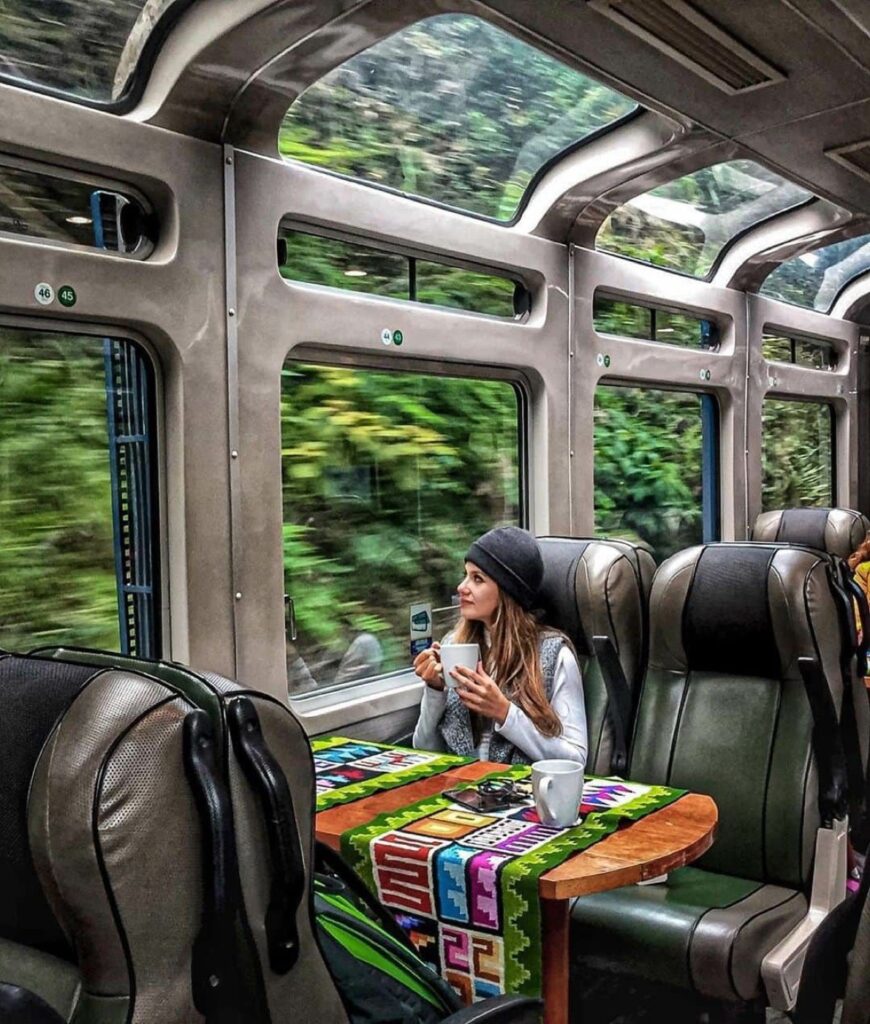
The train station, the main square, and the crafts market are all a few minutes’ walk from each other. From town, the Consettur shuttle bus climbs the switchback road to the citadel gate in about 25 minutes; you can also walk up a direct trail (a steep 1.5-2 hour hike), though almost nobody does if they’re catching the first entry slot.
Where to stay by budget
There are no international luxury chains inside the town itself (the one genuine luxury property sits on separate grounds right next to the citadel, at very high rates). Within Aguas Calientes, lodging clusters into three areas:
| Area | Profile | Advantage |
|---|---|---|
| Near the train station | Budget to mid-range, backpackers and groups | Walk in with your bag, close to the market |
| Along the Urubamba River | Mid to upper-mid range | Canyon views, river sound, a bit more calm |
| Upper part of town | Mid-range, steep stairways | Quieter, better for an early night |
In high season (May to September) it pays to book your stay 3-4 weeks ahead; the whole town fills up fast because hotel capacity is limited relative to the daily flow of visitors. If you’re on an organized tour, lodging is already included in the most convenient area for your itinerary.
The hot springs that give the town its name
About a 10-15 minute walk up a steep street from the main square are the thermal baths that give the town its name: mineral-rich pools at different temperatures, with changing rooms and towel rental. They’re not spa-level — simple public pools that tend to fill up around sunset — but they’re a good way to close out a day of walking the citadel. Entry costs a modest amount in soles, paid at the gate.
Where to eat: local market vs. tourist strip
Aguas Calientes has two very different food scenes just steps apart:
- Local market (near the station): full set menus — soup, main, drink — at prices well below any tourist restaurant. It’s where locals and town workers eat: simple and fast.
- Main tourist strip: dozens of restaurants with multilingual menus, adapted Peruvian cuisine, vegetarian options, and the occasional buffet for groups. Prices climb noticeably above the market, but service is more comfortable if you’re arriving tired from the hike.
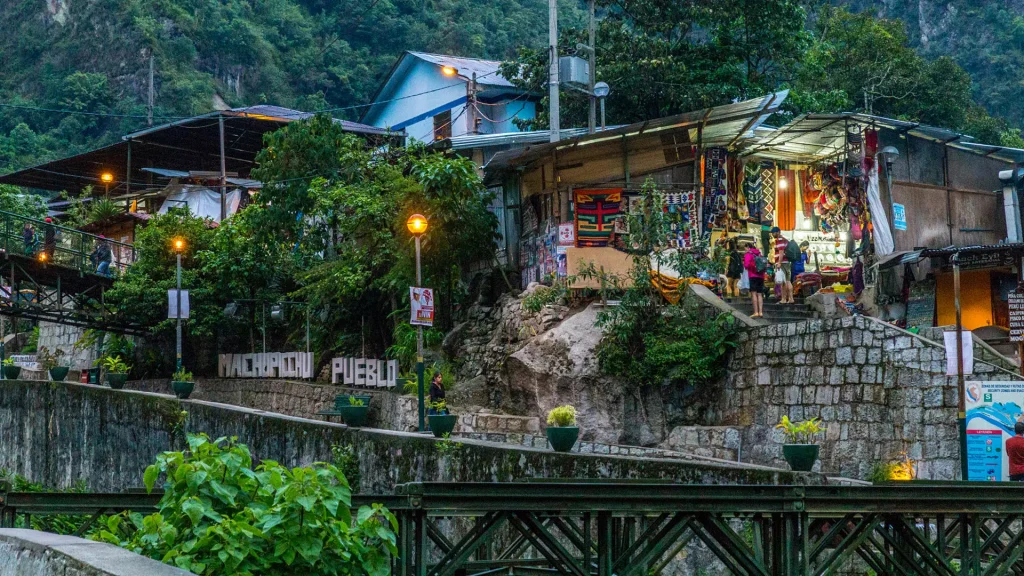
If you’re on a tight budget, eating once at the market and saving the tourist strip for a farewell dinner is a good balance. Carry cash in soles: not every small spot accepts cards.
How long should you stay?
For most travelers, one night in Aguas Calientes is ideal: arrive by train in the afternoon, have dinner and rest, then head up on the first or second bus the next morning to enter the citadel with fewer crowds and better light, before returning by train the same day. Those doing a single-day tour from Cusco (no overnight) also pass through town, but only briefly, on the way to the bus stop. Staying two nights only makes sense if you’re also climbing Huayna Picchu or Machupicchu Mountain at an unhurried pace, or want to explore the town without a rush.
Other things to do in town
Aguas Calientes isn’t just a waypoint: it has its own main square with a simple church, a covered crafts market selling textiles and souvenirs (a bit of bargaining is expected here), and several shops renting trekking poles or selling last-minute rain ponchos. If you have a free afternoon before heading up to the citadel, walking the cobblestone streets along the river, crossing one of the pedestrian bridges, and grabbing a coffee overlooking the canyon is, for many travelers, a memorable part of the trip. There are also a couple of small museums and interpretation centers on Inca culture, useful if your tour doesn’t include a guide inside Machu Picchu itself.
Practical tips
- Book your return train ahead of time. Afternoon departures sell out first in high season; if you’re leaving the citadel late, confirm your train back lines up with your descent.
- Bring repellent. Being in the cloud forest, mosquitoes are part of the scenery, especially at dusk near the river.
- Pack light. The town is all stairways — a big rolling suitcase is a pain on the cobblestone streets. Most lodgings will store your larger bag if you’re heading up with just a day pack.
- Exchange soles before arriving if you can: there are ATMs in town, but fees tend to be high and machines can run out of cash in peak season.
- Wifi is limited. Mobile data is weak because of the canyon’s geography — don’t count on a stable connection for work calls or video chats.
The simplest way to handle all this logistics — train, bus, ticket, and an overnight in town if you want one — is with an organized tour. Check our full-day Machu Picchu tour or the Salkantay Trek to Machu Picchu, which ends precisely with a night in Aguas Calientes before visiting the citadel. Message us on WhatsApp and we’ll build the itinerary around your dates.
 Project Zion™ Theme.
